Damage functions - brief review (Nov 2024)
Originally circulated in Nov 2024
This week the new NGFS scenarios have come out, notably it employs a new damage function. The new damage function, similarly to the damage function that they have been using so far, is based on PIK work, with Leonie Wenz being a common author to both studies. Leonie Wenz has presented in the Bank a couple months ago, but there has been another researcher presenting a very similar paper just last week: Adrien Bilal (Stanford) has been arguing for a slightly different damage function. Given this interest and recent experiences I thought to write a brief summary note on these developments.
First, I have to say that the relevant NGFS technical note on damages is quite good and well written so for a more comprehensive discuss I can certainly recommend reading it. But let's get into the key messages: what does it mean for NGFS damages? How damages are considered now? And what is still missing?
New NGFS damages
So for the NGFS scenarios, the new Kotz et al (2024) based estimates mean an upward adjustment: from a previous 5% of global GDP loss by 2050 in a current policies scenario the assumed damages are increased to 15% of global GDP loss.
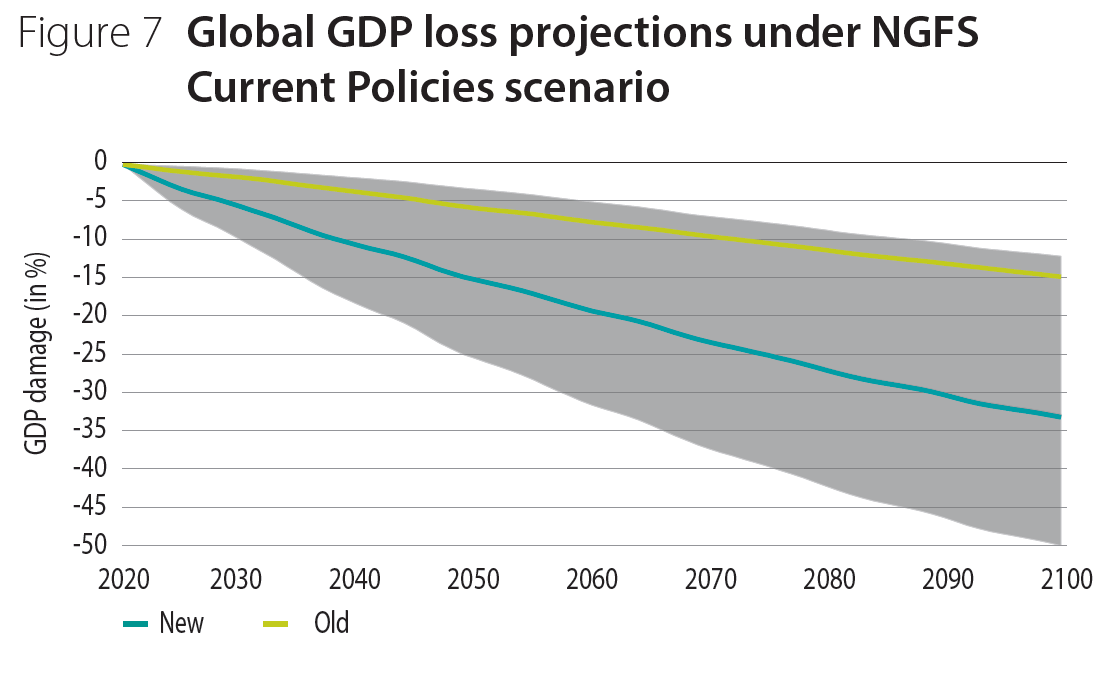
This is a substantial increase, especially as the technical paper notes that previous NGFS vintages were using a high damage assumption, as in they were using the 95th percentile of the damage function, now the communicated 15% is the median of the damage function.
They also note that the temporal dynamics of the damages and the geographical distribution is substantially different from the old damage function outcomes. Notably, effects are even stronger negative for hot countries; and while under a mitigation scenario the long-term outcomes are similar, the new damage function brings a stronger negative medium-term impact - even in the case of strong mitigation action (see figure below).
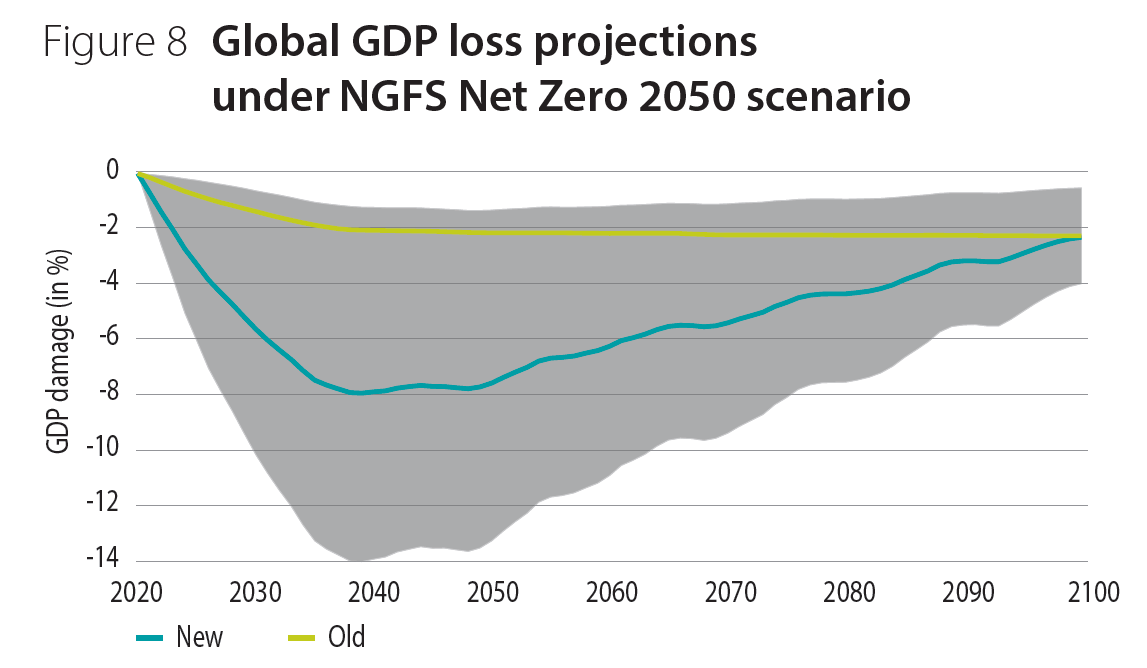
However, as they note, these estimates are still presented in a context of otherwise high economic growth. From today the scenarios still assume a 150-180% growth of GDP by the end of the century (population growth in the same period is assumed to be ~30% compared to today).
Damage functions - new developments
The NGFS technical note presents a table of damage estimates from various studies. These range (for \(3^{\circ}C\) warming) from 2% (Nordhaus, 2014) to 44% (Bilal, 2024) for global GDP loss. (See below)
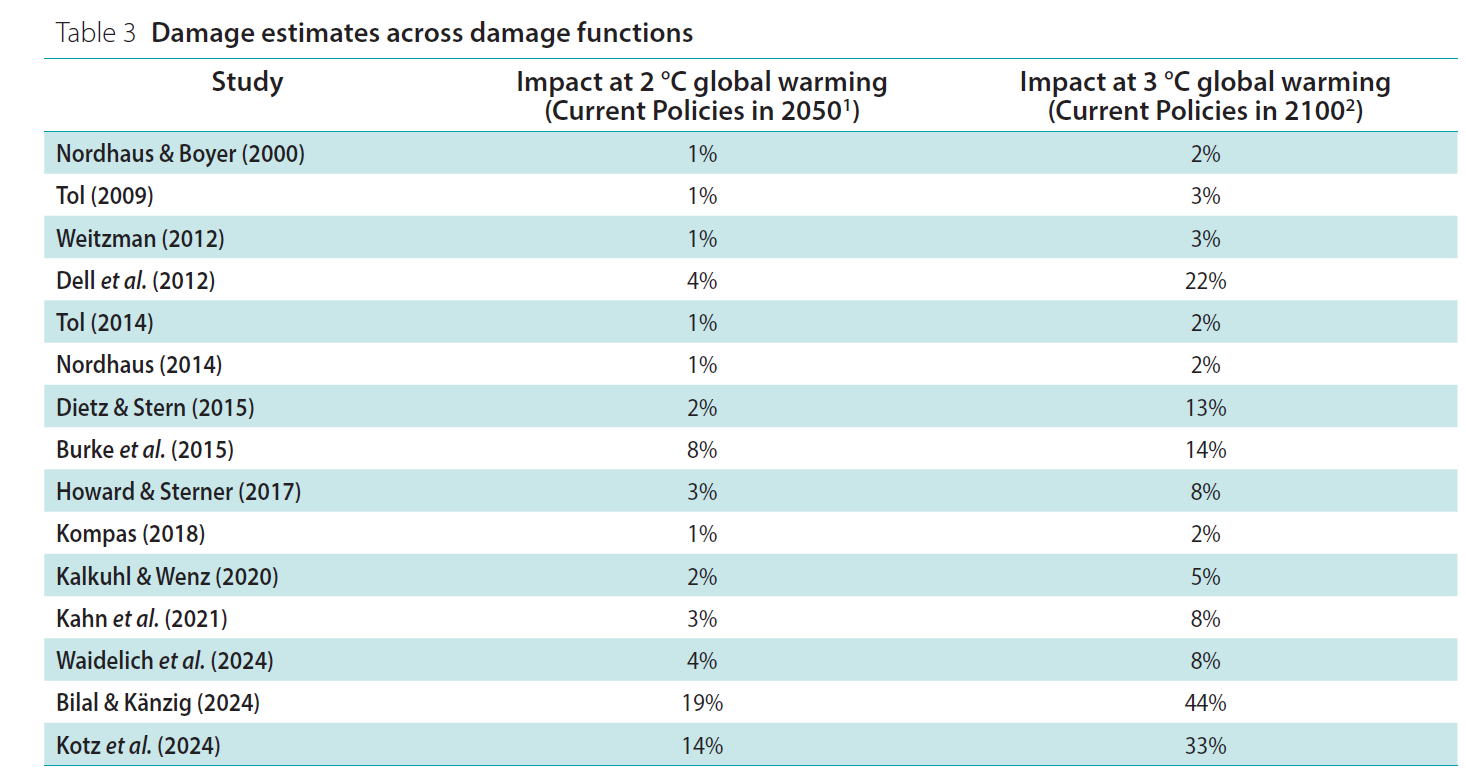
Some of these damages functions are since known to be limited or questionable (e.g., Tol, 2014). In my opinion at least, one of the more robust and used (as in used in applied analysis) estimates are in the Burke at al. (2015) (or also known as Burke & Hsiang) paper, which made the point of non-linear and permanent (i.e., growth decreasing) damages.
Previous NGFS iterations have been using Kalkuhl & Wenz (2020). While currently we are mostly discussing novel studies such as Kotz et al. (2024) and Bilal & Känzig (2024). These four studies all employ an econometric method, where they identify climate damages from observed economic output reactions to various climate variables, but more on this later.
Type of damage functions
So the NGFS note first categorises the damage functions by their calibration methods. They name the following types, I have added some damage estimates from the relevant papers:
| Type | Damage est. \(3^{\circ}\) warming, by 2100 | Ref |
|---|---|---|
| Enumeration | ||
| Expert elicitation / surveys | 2% | Nordhaus (1994) |
| CGE | 3%-5%-6% | Kompas et al. (2018, GTAP) - Roson & van der Mensbrugghe (2010, ENVISAGE) - Fernando and Lepore (2023, G-Cubed) |
| Econometric | 5%-33% | Kalkuhl & Wenz (2020) - Kotz et al (2024) |
| Meta-study | about 2%*-8% | Tol (2024, *\(4.3^{\circ}\) warming, excludes Burke (2015) and Dell (2012) for example) - Howard & Sterner (2017, based on Nordhaus-Tol mostly) |
It is important to note that most applied (modelling) work choose to rely on the econometric estimates, not only because they tend to be more robust in their methods / grounding, but also because they give a more realistic picture of expected damages (if a non-economist looks at them). Some novel exercises, that use other approaches (e.g., CGE), might still use econometric estimation to derive their initial climate damage estimates, that they use to parameterise their modelling (Fernando and Lepore 2023).
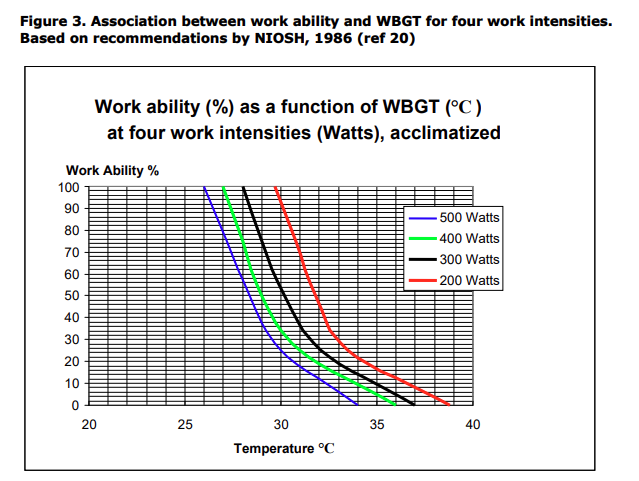
Also, there is a tendency in non-econometric approaches to employ a somewhat circular argument: Tol's meta study (2024) excludes higher estimates (e.g. Burke or Dell) and conclude that the literature agrees on the lower estimate. While CGE approaches (e.g., Kompas et al., 2018) use a damage function calibration based on Roson and Sartori (2016), which is another GTAP based modelling exercise. But in turn Roson and Sartori (2016) base their damage function calibration on Kjellstrom et al. (2009) (corresponding author Richard Tol) who connect labour productivity to heat stress to derive a labour productivity loss measure. But even this paper (Kjellstrom et al., 2009) is actually based on (p13) a non-linear temperature-work ability measure (similar to what is calculated by Burke et al 2015) that is derived from NIOSH recommendations in 1986 (see the figure below, p13 of Kjellstrom et al, 2009; original is Dukes-Dobos, Henschel, and NIOSH, 1986).
Because of all of this and because of NGFS choice to use an econometric damage function I too focus on this in the next parts.
Features of econometric damage functions
There are three main - debated - features that the NGFS technical paper highlights and that differentiate estimated damage functions:
- Climate variables that are accounted for - warming vs. comprehensive
- Linear vs non-linear effects - of the above variables
- Time persistence of effects - level vs. persistent level vs. growth (permanent)
Climate variables
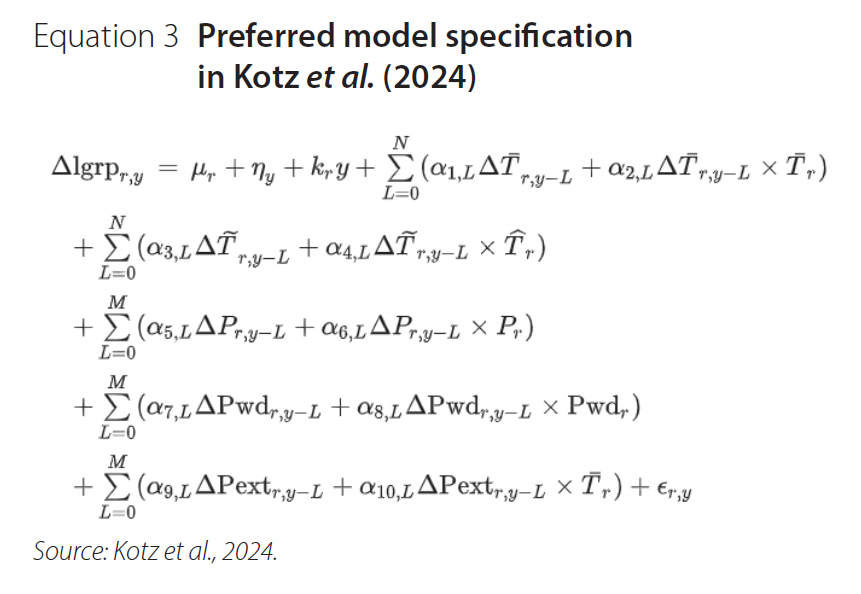
The new NGFS approach (Kotz et al, 2024) takes a comprehensive approach to climate conditions. It considers five climate variables (annual temperature, daily temp. variance, annual precipitation, wet days, extreme precipitation). This is largely in contrast with approaches that are solely rely on average temperature change (e.g., Burke et al, 2015) or clearly argue for a single proxy of climate change (e.g., Bilal & Känzig, 2024). The drawback is obviously that more climate / weather data is necessary for the modelling, the advantage is the better coverage of actual effects.
As the note writes: given that many acute risks / damages are connected to these other climate variables the NGFS assumes that the new damage function can capture these damages too without the need to rely on separate modelling of acute risks. The current NGFS scenario practically removes separately modelled acute damages from its results and replaces it with the Kotz et al estimates.
[!NOTE]
My take: this is definitely a step in the right direction. The economic damage functions, both by economists (Fernando and Lepore 2023) and by natural scientists (Stainforth 2024), have been critiqued for their relative simplicity on the climate side and the fact that they take a very single-minded view of climate change - in many cases just equating climate change with an average temperature increase.The adaptation of Kotz et al's more comprehensive approach enables a more realistic estimation of damages, not just through the temperature channel.
Time persistence of effects
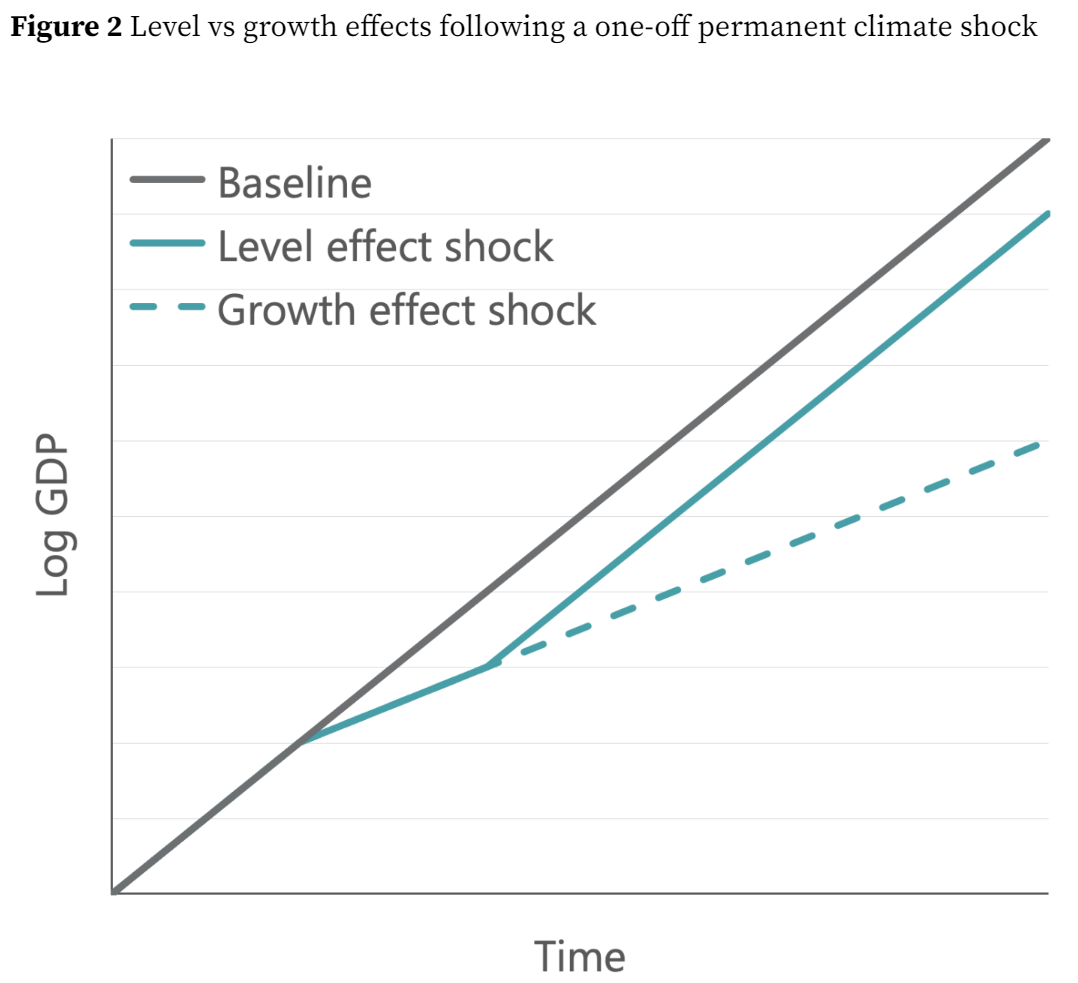
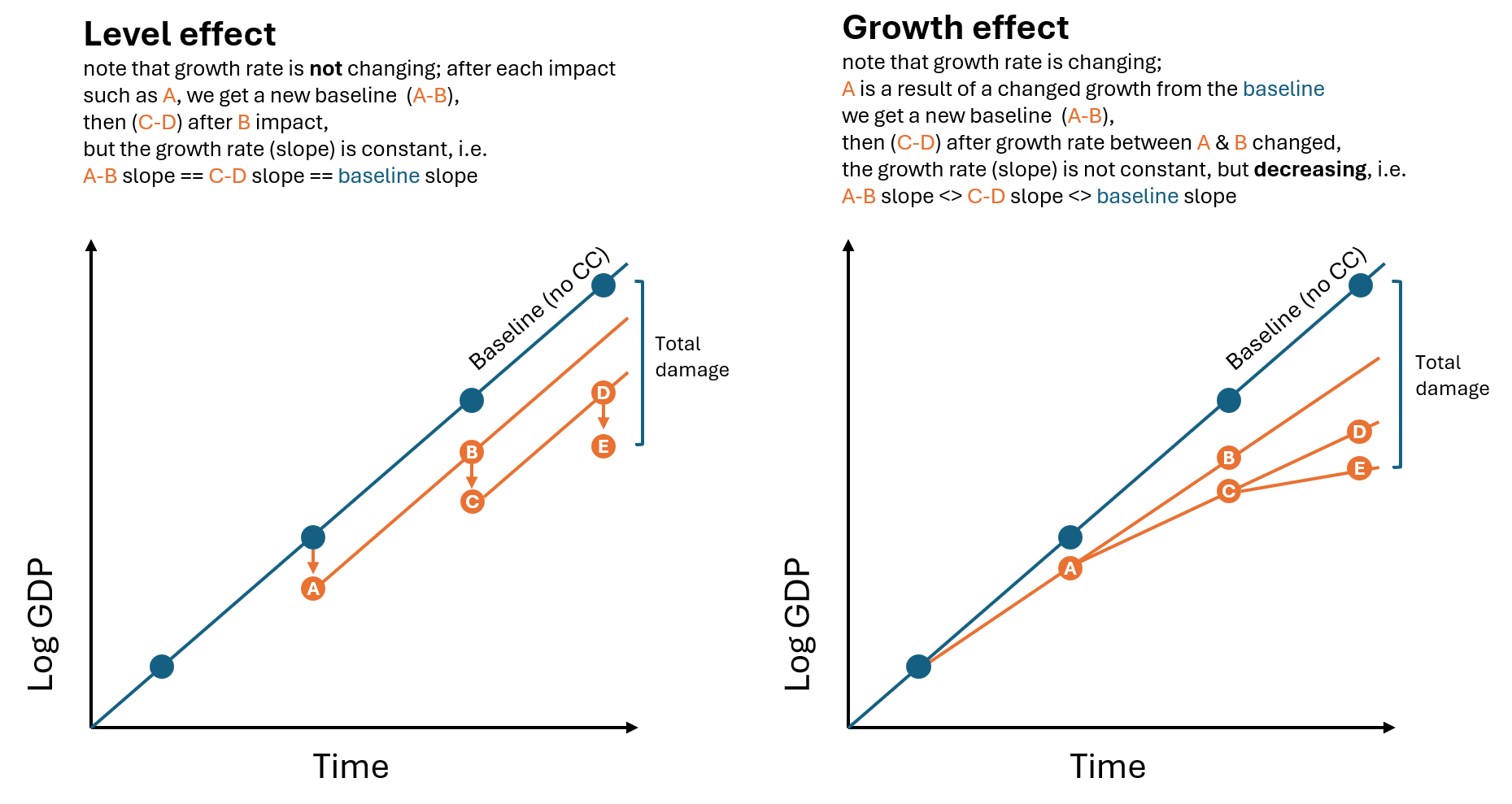
There are two general approaches: a level and a growth approach.
The level effect assumes that a climate shock can effect the level of economic output, but not the growth of it, i.e., after a shock the economy returns to its pre-shock growth path (with possibly lower levels of output). This approach is followed for example by Kalkuhl and Wenz (2020) - the old NGFS damage function.
In contrast the growth effect assumes that climate shock have a permanent impact on the growth rate of the economy. Hence, unless climate returns to the pre-shock state the growth is permanently slowed. This approach is followed by Burke et al. (2015) and Dell et al. (2012).
The figure below, from Aerts, Stracca, and Trzcinska (2024) shows this. In the context of climate change however, we're expecting annual, cascading shocks, not one-off permanent shocks.
We can represent this visually such as:
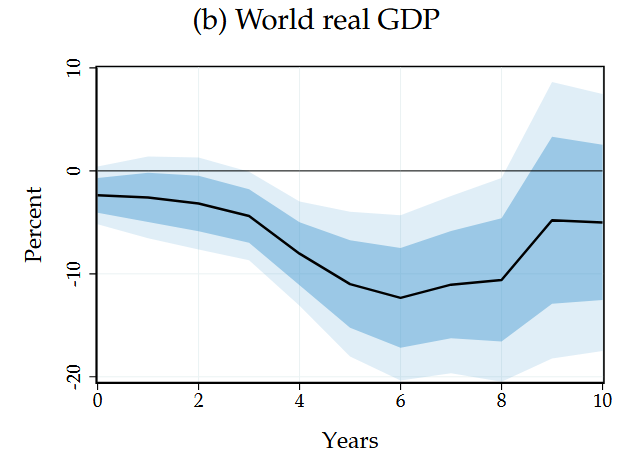
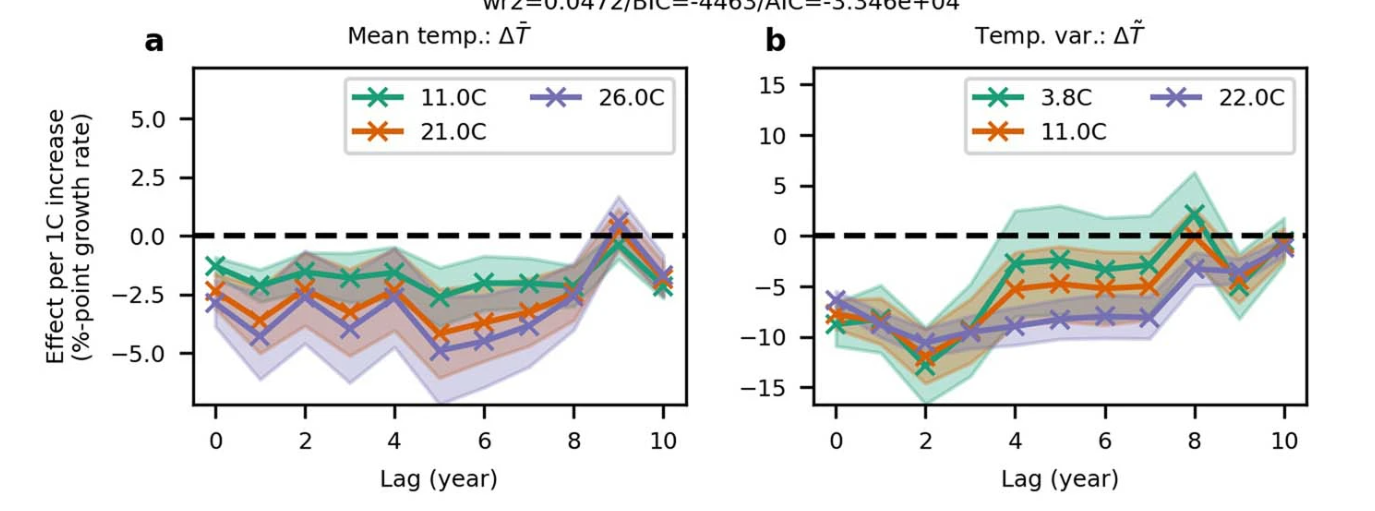
More recently a new approach is adopted, this is the approach used in the NGFS new damage function as well. This approach somewhat combines the level-effect with a growth effect. Both Bilal and Känzig (2024) and Kotz et al (2024) employs this method. The method is labelled a persistent effect* method (in contrast to permanent effect of the growth effect) and while it starts with the assumptions of the level-effect, it employs lagged terms in the estimations, therefore opening up the way towards modelling persistent effects.
The figure below from Bilal and Känzig (2024) illustrates this. In this impulse response chart they show the temporal dynamics of a global temperature shock of \(1^{\circ}\). Kotz et al (2024) specify different lags for their different climate variables: 10 years for temperature, 4 years for precipitation variables. Notably, this also means that the growth rate reverses after the shock to the pre-shock level after the 10 years have passed.
[!NOTE]
My take: Tol (2024) argues that the growth-hypothesis has been proven to be wrong. I don't think he is right. Not only the Burke et al (2015) approach is more intuitive (and easier to understand by non-economists), but Dell et al (2012) also confirmed the effect only for low-income countries, which points into the direction of a vulnerability-persistance relationship. The Kotz et al (2024) approach even positions itself as a middle ground between the two approaches.**While I think theoretically the growth approach is more realistic there are various issues in confirming it empirically (I will get back to this). The persistence approach is indeed a good middle ground, although the duration of persistence might not be independent of vulnerability. **
Functional form - Linear vs non-linear
The question here is whether on higher temperatures we get different damages for a unit change than on lower temperatures. Linear, quadratic as well as higher order polynomials are discussed. Ken Caldeira (NYU) compared some of these functions graphically in a blog post:
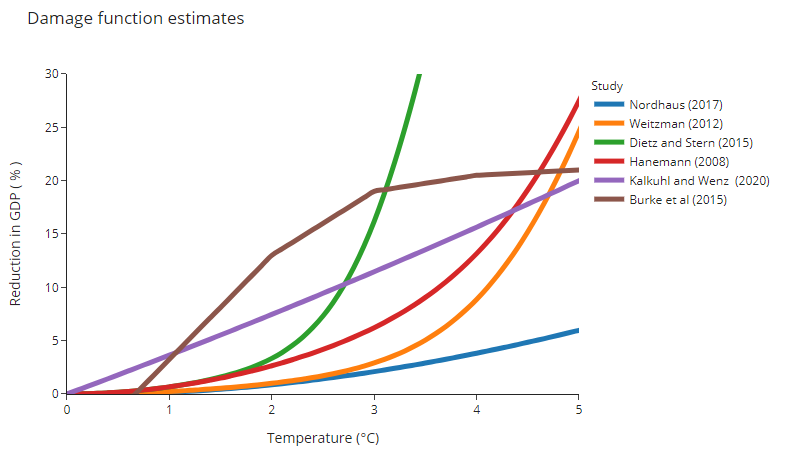
The papers use the following forms:
| Paper | Form |
|---|---|
| Nordhaus (2017) | quadratic |
| Kalkuhl and Wenz (2020) | linear |
| Burke at al (2015) | quadratic, but on growth rate |
| Weitzman (2012) | quadratic |
| Dietz and Stern (2015) | modified non-integer reciprocal polynomial, with the aim of 50% damage at \(6^{\circ}\) warming |
| Kotz et al (2024) | non-linear, with interaction effects with climate variable levels |
| Bilal and Känzig (2024) | linear |
The Kotz et al. (2024) heterogenous effects are illustrated here:
[!NOTE]
My take: we definitely need a non-linear function. The difficulty, as Dietz and Stern (2015) highlight is that we have no idea about what happens at higher levels. Although some disagree (e.g., Bilal) it is quite likely that at higher levels the damages are start to induce further damages, leading to cascading effects. Fortunately, this is not something that we have historical evidence on.Non-linear effects are definitely necessary, and it is a welcome step for the NGFS to include it in the scenarios. However, with regards to higher temperature damages we face the issue that we face with the rest of the modelling exercise as well - we have to rely on much smaller magnitude transitory weather deviations to identify the effect.
What's still missing?
Both the NGFS note and the Kotz et al. (2024) paper can be applauded for presenting various concerns and limitations about the existing / applied methods. I aim to reiterate the main ones or ones that are relevant for our focus, these are the following:
- Identifying climate change impacts from short-term fluctuations
- Tipping points / tail risks
- Long-term adaptation and the implicit short-term adaptation
- Missing impact channels
- Spill-over effects are missing
Identifying climate change from short-term fluctuations
This is a main methodological issue across most of the literature. Kotz et al. (2024), Bilal and Känzig (2024) or even Burke et al (2015) all based on the idea that we can identify the reactions of economic output (or the economic system more generally) based on historically observed reactions of the economic system to short-term deviations in climate variables. Basically, we are trying to say how much less productive labour will be with a \(+1^{\circ}\) average temperature increase based on how much less productive labour was when the average in a given area was \(+0.3^{\circ}\) higher in a given year than usually (of course this is a simplification).
The issue is that climate change is not weather change, or deviation of the weather in a given (short) period (Stainforth, 2024). And apparently to capture the effects of climate change rather than weather change we do not have (on the macroeconomic level) the proper methods / data / etc. This is also why the function form garners more attention that in other economic estimations, because (especially for higher temperatures) we do not have observations, only expectations.
Crucially, while the econometric approach to understand the relationship between climate variables and economic output is an important method and a good starting point, to really understand the economic effects of expected climate change further modelling will need to go beyond what can be known based on statistical models applied to historical data. It will have to evaluate the possible impact channels one-by-one, working with a variety of fields including natural sciences and engineering to build up an understanding of the mechanisms of action and causality, rather than chase correlations.
Tipping points / tails risks
Furthering the previous point: natural science expects that there are various tipping points in the climatic system, which if reached will lead to spiralling and potentially irreversible effects. Meanwhile, tail risks are lower probability, but higher impact climate outcomes that are possible, based on climate science modelling, but are generally less covered in economic calculations.
Both of these factors are missing from damage functions. Damage functions, inherently, also have a average impact approach - as in they consider what is the average damage given the considered climate variables rather than a minimum or maximum impact. These things altogether mean, that while the functions can produce an average outcome, the actual outcome (and damage) might actually be much more catastrophic. Which again, just as tipping points can trigger an economic collapse and lead to cascading effects.
Long-term adaptation and implicit short-term adaptation
The Kotz et al. setup implicitly captures short-term adaptation (assumes that it is happening), while it explicitly excludes the possibility of endogenous long-term adaptation. This varies across damage functions and estimations. While arguments can go both ways, what I think is important to not, that models that are based on historical behaviour necessarily include adaptation in their damage parameters. I.e., when we see a certain damage estimate, that estimate is already mitigated by the adaptation measures that were happening in the past, which means that there is no real do-nothing damage measure, that would be even higher.
Missing impact channels
There are probably many more, what Kotz et al (2024) mention:
- heatwaves
- sea-level rise --> we have no historic evidence
- topical cyclones
- ecosystem collapse
Spill-over effects are missing
Kotz et al (2024) explicitly mention that they do not evaluate the potential for 'spill over' effects between regions and along supply chains. This in their interpretation means that the effects that they present are likely to be conservative, without accounting for these effects. Capturing these effects are methodologically difficult, hence missing from the current literature.
Nevertheless, these are the exact effects that make climate change a global-double phenomena, not only the level of climate change will affect everyone in the world, but also by effecting some it will effect others through a second-order effect. If labour productivity in one country is diminishing due to high temperatures or daily temperature variance, then it might also effect supply-chains towards another country, bringing bottlenecks and further productivity losses through indirect effects as well. Multi-country models and models with supply-chain representation across sectors are especially well placed to provide insights into these secondary damages. However, for this we need comprehensive global scenarios to work with.
References
Aerts, Senne, Livio Stracca, and Agnieszka Trzcinska. 2024. “Measuring Economic Losses Caused by Climate Change.” CEPR. October 2, 2024. https://cepr.org/voxeu/columns/measuring-economic-losses-caused-climate-change.
Bilal, Adrien, and Diego R. Känzig. 2024. “The Macroeconomic Impact of Climate Change: Global vs. Local Temperature.” Working Paper. Working Paper Series. National Bureau of Economic Research. https://doi.org/10.3386/w32450.
Burke, Marshall, Solomon M. Hsiang, and Edward Miguel. 2015. “Global Non-Linear Effect of Temperature on Economic Production.” Nature 527 (7577): 235–39. https://doi.org/10.1038/nature15725.
Dell, Melissa, Benjamin F. Jones, and Benjamin A. Olken. 2012. “Temperature Shocks and Economic Growth: Evidence from the Last Half Century.” American Economic Journal: Macroeconomics 4 (3): 66–95. https://doi.org/10.1257/mac.4.3.66.
Dietz, Simon, and Nicholas Stern. 2015. “Endogenous Growth, Convexity of Damage and Climate Risk: How Nordhaus’ Framework Supports Deep Cuts in Carbon Emissions.” The Economic Journal 125 (583): 574–620. https://doi.org/10.1111/ecoj.12188.
Dukes-Dobos, F. N. (Francis N. ), Austin Henschel, and NIOSH. 1986. “Occupational Exposure to Hot Environments; Criteria for a Recommended Standard.” (NIOSH) 86-113. Criteria for a Recommended Standard. https://stacks.cdc.gov/view/cdc/11174.
Fernando, Roshen, and Caterina Lepore. 2023. “Global Economic Impacts of Physical Climate Risks.” CAMA Working Papers, CAMA Working Papers, , October. https://ideas.repec.org//p/een/camaaa/2023-50.html.
Howard, Peter H., and Thomas Sterner. 2017. “Few and Not So Far Between: A Meta-Analysis of Climate Damage Estimates.” Environmental and Resource Economics 68 (1): 197–225. https://doi.org/10.1007/s10640-017-0166-z.
Kalkuhl, Matthias, and Leonie Wenz. 2020. “The Impact of Climate Conditions on Economic Production. Evidence from a Global Panel of Regions.” Journal of Environmental Economics and Management 103 (September):102360. https://doi.org/10.1016/j.jeem.2020.102360.
Kjellstrom, Tord, R. Sari Kovats, Simon J. Lloyd, Tom Holt, and Richard S. J. Tol. 2009. “The Direct Impact of Climate Change on Regional Labor Productivity.” Archives of Environmental & Occupational Health 64 (4): 217–27. https://doi.org/10.1080/19338240903352776.
Kompas, Tom, Van Ha Pham, and Tuong Nhu Che. 2018. “The Effects of Climate Change on GDP by Country and the Global Economic Gains From Complying With the Paris Climate Accord.” Earth’s Future 6 (8): 1153–73. https://doi.org/10.1029/2018EF000922.
Kotz, Maximilian, Anders Levermann, and Leonie Wenz. 2024. “The Economic Commitment of Climate Change.” Nature 628 (8008): 551–57. https://doi.org/10.1038/s41586-024-07219-0.
NGFS. 2024. “Damage Functions, NGFS Scenarios, and the Economic Commitment of Climate Change.” NGFS. https://www.ngfs.net/sites/default/files/media/2024/11/05/ngfs_scenarios_explanatory_note_on_damage_functions.pdf.
Nordhaus, William D. 1994. “Expert Opinion on Climatic Change.” American Scientist 82 (1): 45–51. https://www.jstor.org/stable/29775100.
Nordhaus, William. 2014. “Estimates of the Social Cost of Carbon: Concepts and Results from the DICE-2013R Model and Alternative Approaches.” Journal of the Association of Environmental and Resource Economists 1 (1/2): 273–312. https://doi.org/10.1086/676035.
Nordhaus, William D. 2017. “Revisiting the Social Cost of Carbon.” Proceedings of the National Academy of Sciences 114 (7): 1518–23. https://doi.org/10.1073/pnas.1609244114.
Roson, Roberto, and Dominique van der Mensbrugghe. 2010. “Climate Change and Economic Growth: Impacts and Interactions.” SSRN Scholarly Paper. Rochester, NY: Social Science Research Network. https://doi.org/10.2139/ssrn.1594708.
Roson, Roberto, and Martina Sartori. 2016. “Estimation of Climate Change Damage Functions for 140 Regions in the GTAP9 Database.” SSRN Scholarly Paper. Rochester, NY: Social Science Research Network. https://doi.org/10.2139/ssrn.2741588.
Stainforth, David. 2024. Predicting Our Climate Future: What We Know, What We Don’t Know, And What We Can’t Know. Oxford: Oxford University Press.
Tol, Richard S. J. 2024. “A Meta-Analysis of the Total Economic Impact of Climate Change.” Energy Policy 185 (February):113922. https://doi.org/10.1016/j.enpol.2023.113922.
Weitzman, Martin L. 2012. “GHG Targets as Insurance Against Catastrophic Climate Damages.” Journal of Public Economic Theory 14 (2): 221–44. https://doi.org/10.1111/j.1467-9779.2011.01539.x.